
INSIGHTS · CAPITAL & FINANCE
Why the Best Time to Prepare for Financing Is Before You Need It
Capital is available. The harder question is whether your business is ready for it.
Authors

Adrian Pryce
Overview
Financing success often depends on decisions made months before an application reaches a lender. We examine capital readiness—the financial, strategic and organizational foundation that helps businesses access the right capital, on better terms, when opportunity or necessity arrives.
For many business owners, financing begins with an immediate need.
- A large contract arrives.
- Equipment needs to be replaced.
- Receivables are stretching longer than expected.
- A competitor becomes available for acquisition.
- A new location presents itself.
- Payroll and supplier obligations arrive before customer payments.
Only then does the search for financing begin. That sequence is backwards
Accessing capital effectively is rarely just a matter of finding a lender willing to provide money.
Banks, government-backed lending programs, private lenders, equipment financiers, factors and equity investors are all trying to answer variations of the same underlying question:
Is this a business we can confidently put capital behind?
Answering that question requires much more than completing a loan application.
It requires what we call capital readiness.
What Is Capital Readiness?
Capital readiness is the ongoing process of preparing a business to access and deploy capital when it is needed.
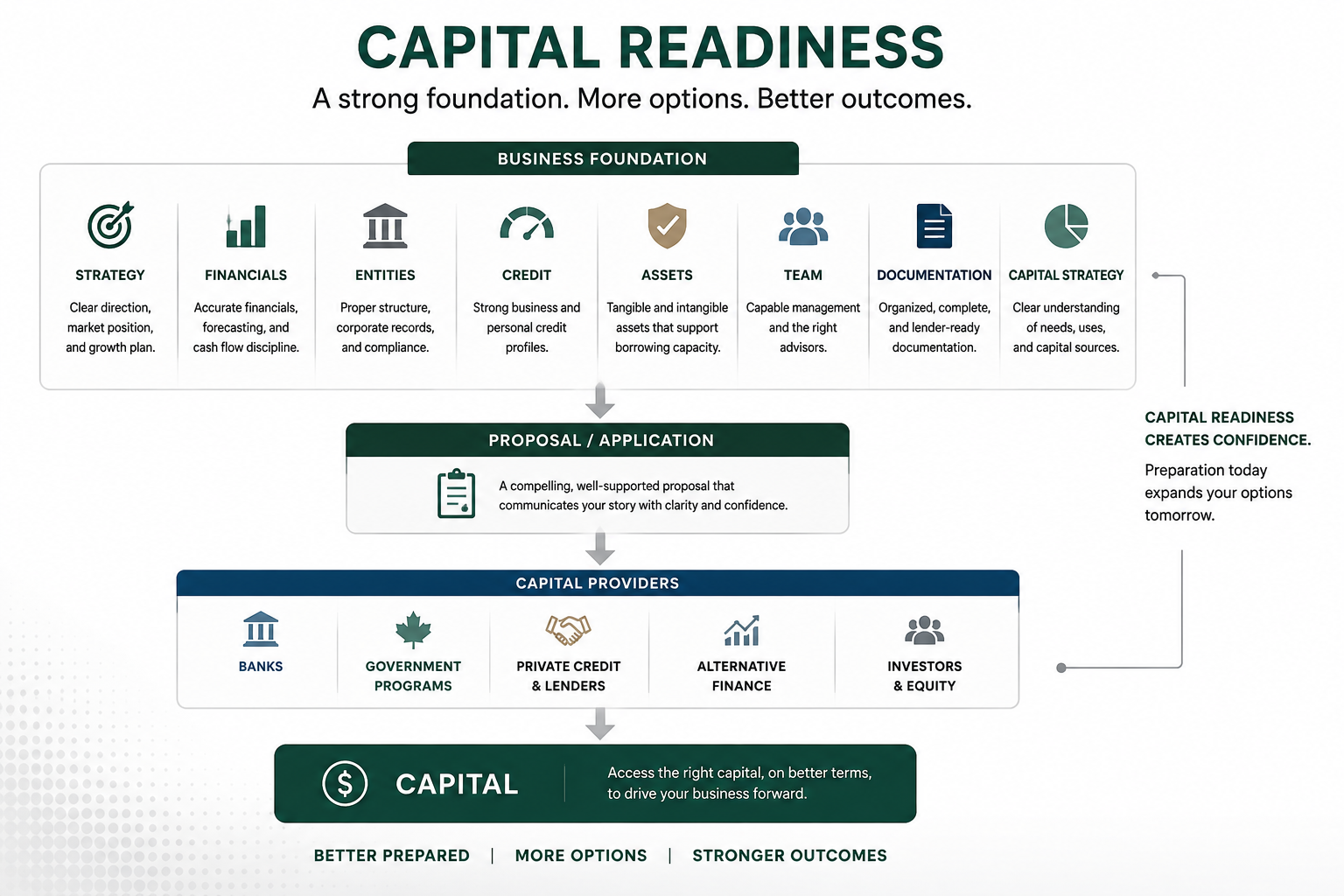
At Cedargrove, we think about that preparedness across several interconnected dimensions: business strategy, financial performance and reporting, corporate entities, credit, assets, management and personnel, documentation, financing strategy and the quality of the proposals presented to capital providers.
A capital-ready company should be capable of clearly explaining:
- what the business does and why it is viable;
- where it is going and how it intends to get there;
- how it has performed financially;
- what its current financial position looks like;
- what future cash flows could reasonably support;
- who is responsible for executing the strategy;
- what assets, collateral or equity support the business;
- why capital is required;
- how that capital will be deployed; and
- how the lender or investor will ultimately be repaid or earn a return.
None of these questions is particularly exotic.
The difficulty is that many businesses do not begin assembling the answers until somebody asks for them.
There is no shortage of capital.
C$1.9B
Financing delivered through Canada's Small Business Financing Program in 2024–25.
C$294K
Approximate average CSBFP loan size.
C$922M
CSBFP financing delivered in Ontario.
US$45B
SBA-backed 7(a) and 504 lending in FY2025.
Sources: ISED Canada and U.S. SBA.
The scale of small-business lending illustrates an important distinction between capital availability and capital accessibility.
Canada's Small Business Financing Program facilitated 6,409 loans worth nearly C$1.9 billion in 2024–25, the largest dollar value in the program's history. The average loan reached approximately C$294,000. Start-ups and businesses operating for less than one year received C$1.4 billion—74.1% of total lending under the program. Ontario alone accounted for 2,957 loans representing approximately C$922 million.
The United States operates at an even greater scale. During fiscal 2025, the U.S. Small Business Administration guaranteed approximately US$45 billion across 85,000 7(a) and 504 loans. Of that total, approximately US$37 billion was delivered through 7(a) loans and US$7.8 billion through the 504 program.
Capital, in other words, continues to move.
But it does not move without purpose. It often feels concentrated to a specific group or demographic; when in actuality it is gravitating to those who have their businesses documented and aligned with a benchmark set of rules for obtaining it.
Financing Is Not Simply an Approval-or-Decline Question
One of the more revealing Canadian statistics comes from Innovation, Science and Economic Development Canada's analysis of small-business credit conditions.
In 2025, approximately 39% of Canadian small businesses sought some form of external financing, while roughly 20% sought debt financing. Among businesses seeking debt, the approval rate was a remarkably high 97%, compared with 89% the previous year.
At first glance, that might seem to undermine the argument that businesses have difficulty accessing financing.
It actually tells us something more useful.
Businesses often self-select before applying. Some businesses never approach conventional lenders because they expect they will not qualify. Others seek expensive alternative financing because their financial records, credit profile or circumstances leave fewer options available. And an approval itself does not tell us whether a borrower received the amount, structure, pricing or terms that would have been available to a stronger applicant.
Consider another statistic from the same data: 75% of Canadian small businesses obtaining debt financing in 2025 were required to pledge collateral, up from 66% in 2024. Working and operating capital represented 45% of intended borrowing, while debt consolidation reached 24%—its highest share in a decade.
That is why the more useful question is not:
“Can I get a loan?”
It is:
“What capital can my business access, from whom, at what cost, under what conditions—and will that capital actually advance the business?”
Those are very different questions.
75%
of business obtaining debt financing that were required to pledge collateral.
97%
approval rate among Canadian small businesses that sought debt financing in 2025.
45%
of intended small-business borrowing was for working or operating-capital.
24%
was intended for debt consolidation - the highest proportion in a decade.
Source: ISED, Small Business Credit Condition Trends 2015–2025.
The Cost of Waiting Until You Need Money
A financing application frequently exposes weaknesses that already existed inside the business.
Financial statements may be months or years behind. Bookkeeping may need to be cleaned up. Corporate tax returns may be outstanding. Personal and business credit may contain unresolved issues. Corporate records may not match the current ownership structure. Revenue may be growing while cash flow deteriorates. Accounts receivable may be aging. Forecasts may not exist. The owner may understand the business intuitively but have difficulty translating that understanding into a lender-grade business case.
The result is an unfortunate paradox:
The moment when a business most urgently needs capital is often the worst moment to begin preparing for it.
Time becomes the enemy.
A lender requesting updated financial statements cannot necessarily wait while two years of bookkeeping are reconstructed. An acquisition opportunity may disappear while corporate records are being reorganized. A large customer will not necessarily postpone a purchase order while the supplier arranges working capital.
And urgency tends to reduce options.
A company that might have qualified for conventional bank financing six months earlier can find itself considering higher-cost private or alternative capital because its financing requirement has become immediate.
Capital readiness is therefore partly about preserving optionality.
What Capital Providers Are Really Evaluating
Different lenders and investors use different underwriting methodologies, but most capital decisions ultimately converge around several basic areas.
- Business viability
Capital providers want to understand whether the underlying business makes economic sense.
That includes the market, competitive position, revenue model, customers, margins, growth strategy and the risks capable of disrupting the company.
A business plan should therefore be more than a document created for a financing application. It should be evidence that management understands the business it is asking somebody else to finance.
- Financial health
Historical financial statements tell the story of what has already happened.
Management reporting explains what is happening now.
Forecasts demonstrate what management believes happens next.
Capital providers will often examine revenue trends, margins, cash flow, debt-service capacity, working-capital requirements, customer concentration, accounts receivable, existing liabilities and the assumptions underlying future performance.
The owner who is comfortable with these numbers inspires considerably more confidence than one encountering them for the first time during underwriting.
- Documentation
Good businesses can look surprisingly weak when their records are disorganized.
Financial statements, tax filings, bank statements, corporate documents, contracts, leases, shareholder records, asset information, insurance, customer agreements and other supporting material collectively form the evidence behind the financing story.
Our capital-readiness framework emphasizes having all of the evidence ready before it is requested.
This is one reason a properly organized data room is useful long before a company contemplates selling itself or raising institutional capital.
- Creditworthiness, collateral and equity
Business credit, personal credit where guarantees are required, existing covenants, leverage, assets and shareholder equity all affect both the availability and cost of capital.
These factors cannot always be repaired quickly.
Creditworthiness is accumulated.
So is equity.
So is a history of meeting financial obligations.
Treating them as ongoing corporate assets rather than financing-application requirements fundamentally changes how management approaches them.
- Management and the team
Capital providers are ultimately backing people as well as spreadsheets.
A company dependent entirely on one owner carries different execution risk from one with capable financial, operational, sales and management resources surrounding it.
That does not mean every small company requires a large executive team.
It means the business needs access to the capabilities required for its next stage.
Sometimes those capabilities reside with employees. Sometimes they come from accountants, lawyers, technology providers, consultants, financing advisors and other outside professionals.
Increasingly, building the right ecosystem around the owner may be as important as building the internal organization itself.
Why Capital Readiness Matters More in the Current Environment
The economic environment confronting Canadian and American businesses in 2026 reinforces the importance of preparation. This is the elephant in the room no has been able to ignore in recent months.
In Canada, the Bank of Canada's second-quarter Business Outlook Survey found that business sentiment had deteriorated after improving during the previous three quarters. Sales expectations softened, geopolitical uncertainty increased and more firms expected rising input costs. The percentage of businesses planning or budgeting for a Canadian recession during the following 12 months increased from 9% to 17%.
Trade uncertainty compounds the problem.
Statistics Canada reported that 34% of Canadian businesses expected U.S. tariffs on Canadian imports to negatively affect their business over the following 12 months. The exposure was considerably greater in some industries: 54% of manufacturers and 47.1% of wholesale businesses expected negative effects. More than 28% of businesses had already passed tariff-related cost increases on to customers.
The United States presents a somewhat different picture.
Small-business optimism improved during the summer of 2026, with the NFIB Small Business Optimism Index reaching 99.8 in July, above its 52-year average. Yet its Uncertainty Index remained at 91, far above its historical average of 68. Twenty-seven percent of owners identified labour quality or availability as their single most important problem, while 36% reported job openings they could not fill.
Meanwhile, the Federal Reserve's July 2026 lending survey found that commercial and industrial lending standards had generally remained unchanged for firms of all sizes during the second quarter. Small-business loan demand was also essentially unchanged. Although C&I conditions had improved compared with the prior year, lending standards remained relatively tight in several other credit categories.
Put these conditions together and a clear picture emerges.
Businesses are operating in an environment where capital remains available, but where uncertainty around demand, trade, input costs, labour, interest rates and geopolitics can rapidly change assumptions.
That makes resilience more valuable.
And resilience is difficult to manufacture during a crisis.
Capital Readiness Is Really Business Readiness
This leads to a broader conclusion.
Most of the work required to make a company attractive to lenders also makes it a better company.
- Accurate financial reporting improves management decisions.
- Cash-flow forecasting identifies problems earlier.
- Strong corporate governance reduces risk.
- Documented processes make companies less dependent on individuals.
- Better credit reduces the cost of capital.
- A capable management and advisory team improves execution.
- Technology creates better information and operational efficiency.
- Strategic planning forces management to determine where capital can generate the greatest return.
- Good documentation allows decisions to happen faster.
In other words, capital readiness is more about sound infrastructure than paperwork.
A business that maintains this infrastructure continuously is better positioned not only to borrow money, but also to pursue acquisitions, respond to RFPs, negotiate with suppliers, attract investors, purchase equipment, enter new markets, withstand disruptions and capitalize on opportunities its competitors cannot.
Build the Platform Before the Opportunity Arrives
Business owners already carry an extraordinary number of responsibilities.
They are responsible for customers, employees, operations, procurement, sales, strategy, compliance and the dozens of unexpected problems that arrive before lunch.
Expecting an owner to simultaneously understand the requirements, products and underwriting preferences of banks, government programs, private lenders and alternative capital providers is unrealistic.
This is where the role of the modern business advisor becomes increasingly important.
A good advisor should not simply appear when a financing application needs to be submitted.
The better model is to work with the business beforehand—helping management identify weaknesses, organize financial information, improve reporting, address corporate and credit issues, develop forecasts, assemble documentation, evaluate financing alternatives and build the broader professional team required to support growth.
Then, when capital is required, the conversation begins from a position of preparation rather than urgency.
Financing Should Be a Strategic Decision, Not an Emergency
There will always be circumstances where businesses need money unexpectedly.
But many financing disappointments are actually predictable.
- The bookkeeping was already behind.
- The tax filings were already outstanding.
- The credit issue was already there.
- The cash-flow problem had already begun.
- The ownership structure was already unclear.
- The business plan had never been written.
- The forecasts had never been prepared.
- The documentation had never been organized.
The financing application simply brought those issues into view.
That is why the best time to begin preparing for capital is not when the banker requests the documents.
It is months—or sometimes years—before the capital is required.
At Cedargrove, we believe businesses should maintain a Capital Readiness Platform throughout their lifecycle: a coordinated foundation encompassing strategy, financials, entities, credit, assets, people, documentation, proposals and financing relationships.
Because when the acquisition appears, the contract is awarded, the new location becomes available or the market suddenly shifts, the companies best positioned to act will rarely be the ones that begin preparing that morning.
They will be the ones that were already ready.
Is Your Business Capital Ready?
Before approaching a lender or investor, understand how your business is likely to be viewed from the other side of the table.
Cedargrove works with business owners to evaluate the financial, operational, strategic and documentation gaps that can stand between a company and the money it needs. We then help build the systems, materials and financing strategy required to approach the market from a position of strength.
Start with a Capital Readiness Assessment and find out where your business stands before your next financing opportunity depends on it.
Let's Talk About It
Schedule a call that can help you clarify your biggest opportunities and priorities.
We empower businesses with winning strategies, innovative financing, future ready technology, and management expertise; working alongside them to grow and reach their highest potential in the marketplace.